Solution for scaling startups
Scale your startup without turning responsibilities into guesswork
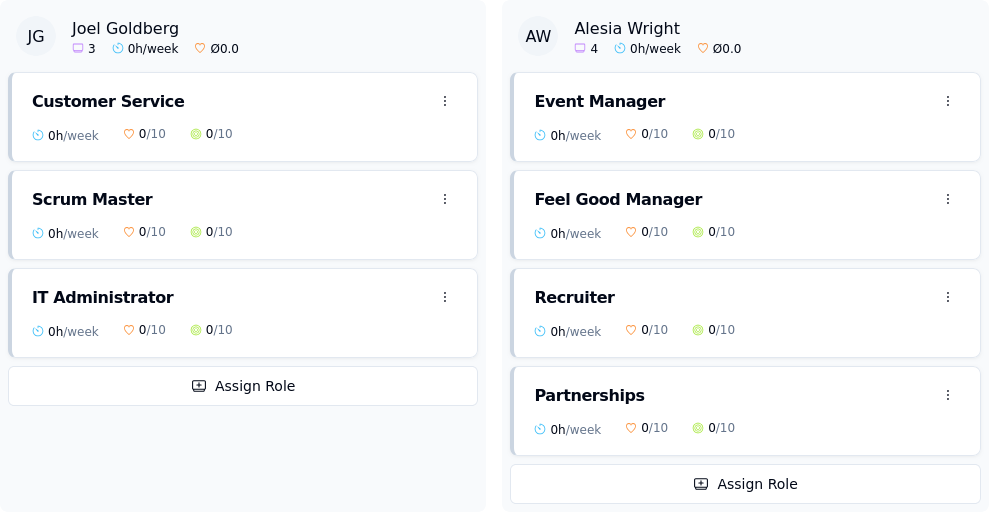
When founders, early hires, and new managers all carry overlapping responsibilities, growth creates drag. Keyroles gives growing teams a living org chart with clear roles, current ownership, and decision boundaries, so onboarding gets faster and cross-functional work keeps moving.
External source
Gallup reported in January 2025 that only 46% of employees clearly know what is expected of them at work, down from 56% in March 2020. For scaling teams, that often shows up as a role-clarity and structure problem, not just a communication gap.
Read the Gallup researchWhat usually breaks first when a startup scales
At five people, context lives in conversations. At twenty, it starts living in Slack and recurring meetings. At fifty, unclear ownership becomes expensive.
- Founder bottlenecks: decisions still bounce back to one or two people because ownership is implicit.
- Onboarding drift: new hires inherit fragments of context instead of a reliable map of responsibilities.
- Cross-team friction: product, operations, revenue, and customer teams all touch the same work, but nobody is fully sure who decides what.
- Role overlap: work gets duplicated, dropped, or escalated because the structure never catches up with reality.
If your team still relies on a static org chart or a Notion page, the structure drifts as soon as hiring accelerates. We wrote more about that in our guide to static vs dynamic org charts.
A living org chart for startup growth
Keyroles helps scaling startups move from vague job descriptions and tribal knowledge to explicit, adaptable roles.
- Map real work instead of idealized titles.
- Give each role a purpose, clear accountabilities, and an owner today.
- Track changes so new hires and existing team members trust the structure they see.
- Make delegation easier for founders and team leads without forcing a full re-org.
This page is about scaling execution and onboarding clarity. If your main challenge is designing a broader operating model with circles and governance rituals, see Hybrid Governance. If your main challenge is cost transparency across products or value streams, see Profitability Allocation.
How Keyroles supports scaling teams
1) Faster onboarding: New hires can see what each role exists for, who holds related responsibilities, and where decisions sit right now. That cuts the familiar "ask three people, get four answers" loop.
2) Cleaner delegation: Founders can split work into explicit roles before they become bottlenecks. Team leads can hand over responsibilities without rewriting job descriptions every quarter.
3) Less overlap, more accountability: Product, operations, revenue, and customer teams often collide during growth. Clear role boundaries reduce duplicated effort and dropped ownership.
4) Better re-orgs in small steps: Instead of waiting for a painful restructure, you can adapt the org continuously as new hires, new products, or new teams appear.
Who gets value from this
Scaling startups usually need more clarity before they think they need "governance". This solution is especially useful for:
- Founders who want to delegate without losing visibility.
- Team leads who need cleaner handovers across functions.
- People and operations teams who want onboarding to reflect reality, not last quarter's org chart.
Signals you are ready for a scaling solution
You do not need a heavy transformation program. You need a system that keeps pace with growth.
Founder dependency is slowing decisions
Important questions still bounce back to one or two people because ownership is implicit rather than documented.
Hiring creates ambiguity faster than clarity
Every new hire changes interfaces, responsibilities, and decision paths, but the structure is still managed in docs and memory.
Onboarding feels like archaeology
New team members spend weeks piecing together who owns what across Slack, Notion, meetings, and personal context.
Re-orgs are becoming the default fix
Instead of small structural improvements, the team waits for a bigger, disruptive reset because change is too hard to manage continuously.
Frequently Asked Questions
Scale with clarity
If growth is creating more handovers, more meetings, and more "who owns this?" moments, Keyroles gives you the structure to keep moving without over-bureaucratizing the company.
Need a different angle?
Explore Hybrid Governance if you are designing authority and decision-making patterns, or Profitability Allocation if you need cost visibility across products and services.